Would you like to discuss which platform is right for your project?
Contact us
Blog
April 7, 2026
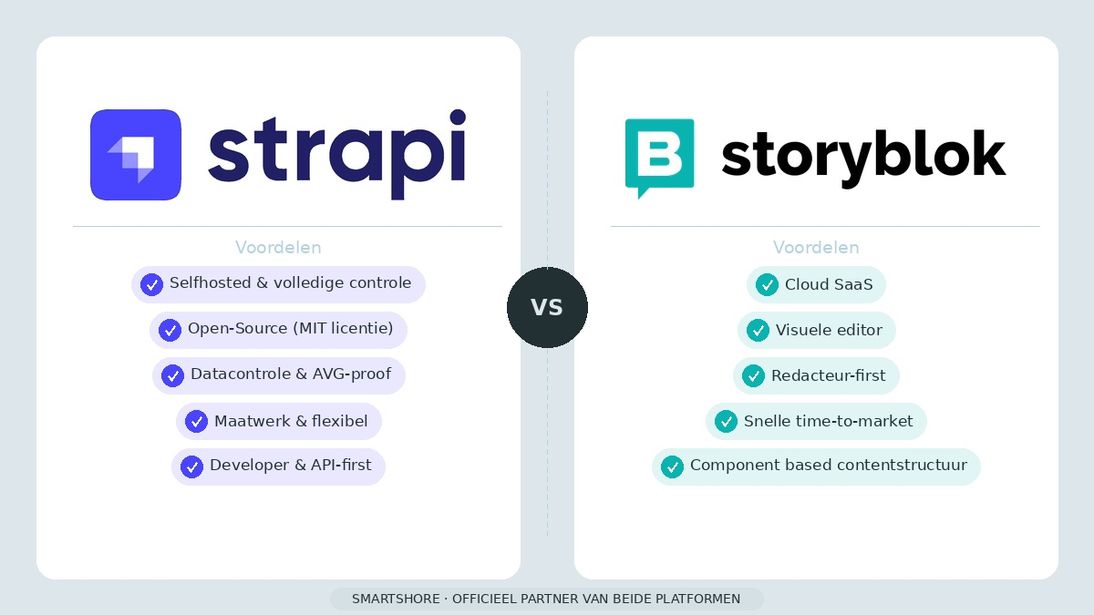
Once you’ve decided that a headless CMS is the right direction for your platform or website, the next question naturally arises: which platform should you choose? Strapi and Storyblok are two of the most widely used headless CMS platforms today, and both frequently come up in consultations and tenders.
At first glance, they appear similar, but they are fundamentally different products with distinct philosophies, target audiences, and strengths. The choice between the two depends on what your organization needs, not on what sounds most impressive on paper.
Smartshore is official partner of both platforms, the only official Strapi partner in the Netherlands and also official Storyblok partner. We work with both systems daily and can clearly see in practice when one is a good fit and the other isn’t. We’re sharing that experience here.
Strapi is an open-source headless CMS that can be fully self-hosted. You install it on your own infrastructure, in a private cloud, or with a hosting partner of your choice. The source code is publicly available; you manage everything yourself and are not dependent on an external SaaS provider.
 This gives you maximum control—over your data, your environment, and your configuration. For organizations that work with privacy-sensitive information, that must comply with the GDPR, or that for other reasons do not want user data to reside outside their own infrastructure, this is a significant advantage.
Strapi excels in technical flexibility. Developers can extend, customize, and integrate the platform with virtually any other service or database. You build the content structure entirely according to your own needs, without the limitations of a predefined model.
Storyblok is a cloud-based headless CMS with a visual editor as its key feature. Editors can see exactly what their content looks like as they edit it, without having to open a preview environment or needing technical knowledge to understand what they’re doing.
 This makes Storyblok particularly well-suited for environments where non-technical users work independently. Marketing teams, editorial staff, communications departments: people who want to manage content without relying on a developer for every change.
Storyblok is hosted by the platform itself. You don’t have to manage any infrastructure; updates are performed automatically, giving you a working environment faster. The trade-off is less control over where your data is stored and a reliance on Storyblok’s roadmap and policies as a company.
The fundamental difference lies in who the primary user is and what that user needs most.
Strapi is built from the developer’s perspective. Its strengths lie in technical freedom, self-hosting, and customization. If you have a complex data structure, require many integrations, or have specific infrastructure requirements, Strapi is the better choice.
Storyblok is built from the editor’s perspective. Its strengths lie in ease of use, the visual editor, and the low barrier to entry for non-technical users. If content management is the main activity and the technical environment is less complex, Storyblok is often the better choice.
That’s not to say Strapi is unpleasant for editors or that Storyblok isn’t technically capable. But the primary focus differs, and you’ll notice that in practice.
Strapi is a good fit for your situation if one or more of the following points apply.
You work with privacy-sensitive or confidential data and want full control over where that data is stored. Think of government organizations, healthcare institutions, or financial service providers that do not want to be in a public cloud.
You have a complex content structure with many different content types, relationships between content, and custom fields that a standard CMS does not offer.
You are building a platform where the CMS is just one part of a larger technical architecture, in which integrations with other systems, databases, or APIs play a central role.
You don’t want recurring SaaS subscription costs that scale with usage or user numbers, but prefer one-time implementation costs combined with in-house management.
You have a technical team or a partner who can manage, maintain, and expand the platform.
Storyblok is a good fit for your situation if the following points sound familiar.
Content management is at the heart of your operations, and the people doing it aren’t tech-savvy. Storyblok’s visual editor significantly lowers the barrier to entry and reduces the need to rely on developers for day-to-day updates.
You want a stable, functioning environment quickly without the overhead of self-hosting, updates, and infrastructure management.
You’re working on a website or platform where the content structure is relatively straightforward and the emphasis is on publication speed and editorial freedom.
Data sovereignty isn’t a strict requirement, and you’re comfortable with your data being stored in a cloud environment managed by Storyblok.
Both platforms have different cost structures, and it’s important to understand them thoroughly before making a decision.
Strapi itself is open source and free to use. The costs are associated with implementation, hosting, and management. Depending on the complexity of the project and the infrastructure choices, these costs can vary, but you do not pay per user or per API call. For larger platforms with many users or high traffic, this can be a significant advantage.
Storyblok operates on a subscription model. There is a free tier for small projects, but for professional applications, you pay monthly based on users, locales, or other factors. The costs are predictable and transparent, but they do increase as platforms grow.
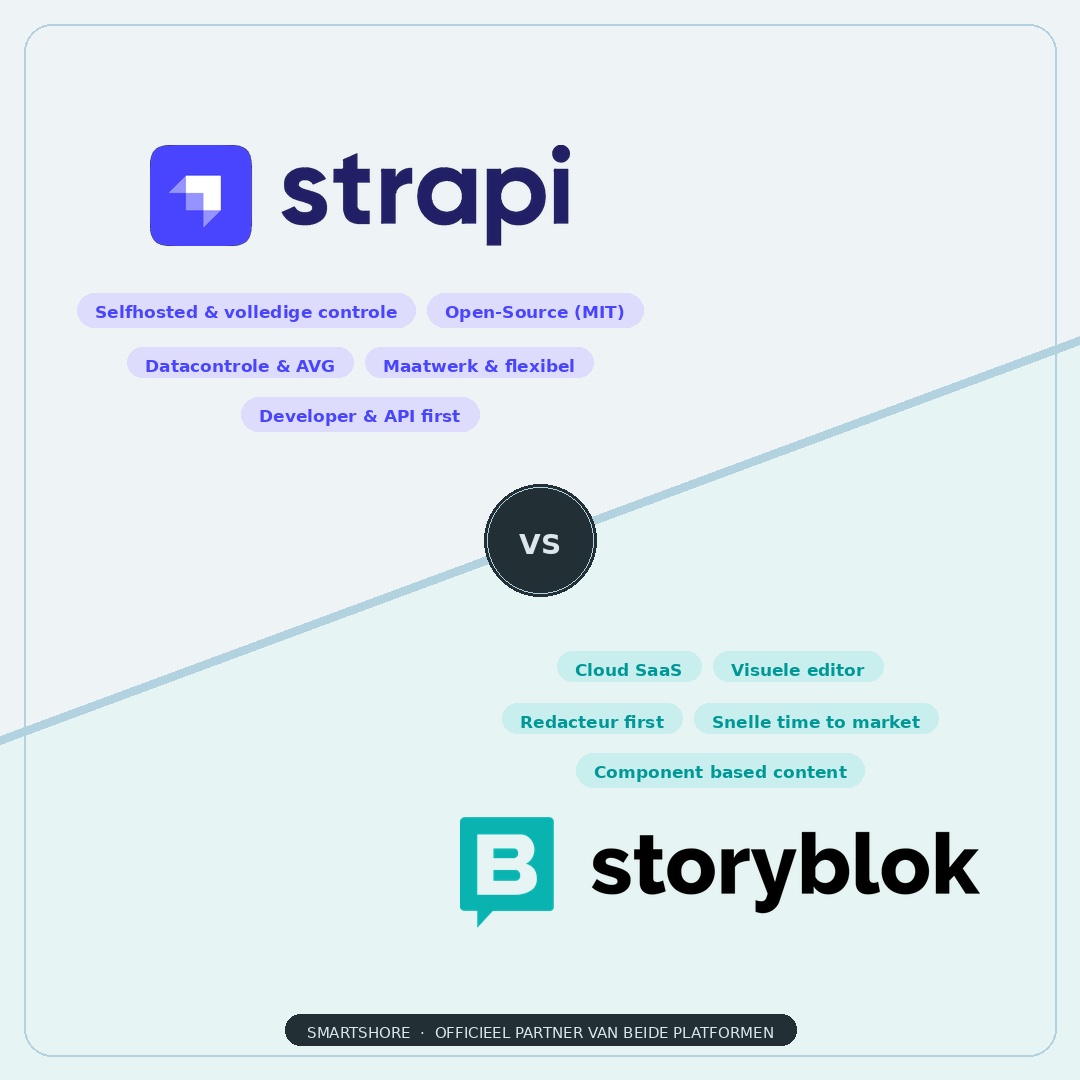 A combination is also possible
It’s not a rule that you always have to choose one or the other. There are situations where an organization uses both platforms: Strapi for technically complex back-end integrations and Storyblok for front-end content editing. This architecture exists and can provide the best solution in specific situations.
But for most projects, a clear choice is the starting point, and that choice makes implementation simpler and management more straightforward.
Here’s the honest summary.
Choose Strapi if control, technical freedom, and data sovereignty are your top priorities.
Choose Storyblok if ease of use for editors and rapid implementation are your top priorities.
At Smartshore, we help organizations make that decision based on their specific situation and requirements. Not based on a preference for one over the other, but based on what’s the best fit. We’re a partner of both platforms and can handle implementation, integrations, and management for either one.
Contact us

